The Sovereign Sound: Why PipeWire + Helvum is the "Diamond" Standard

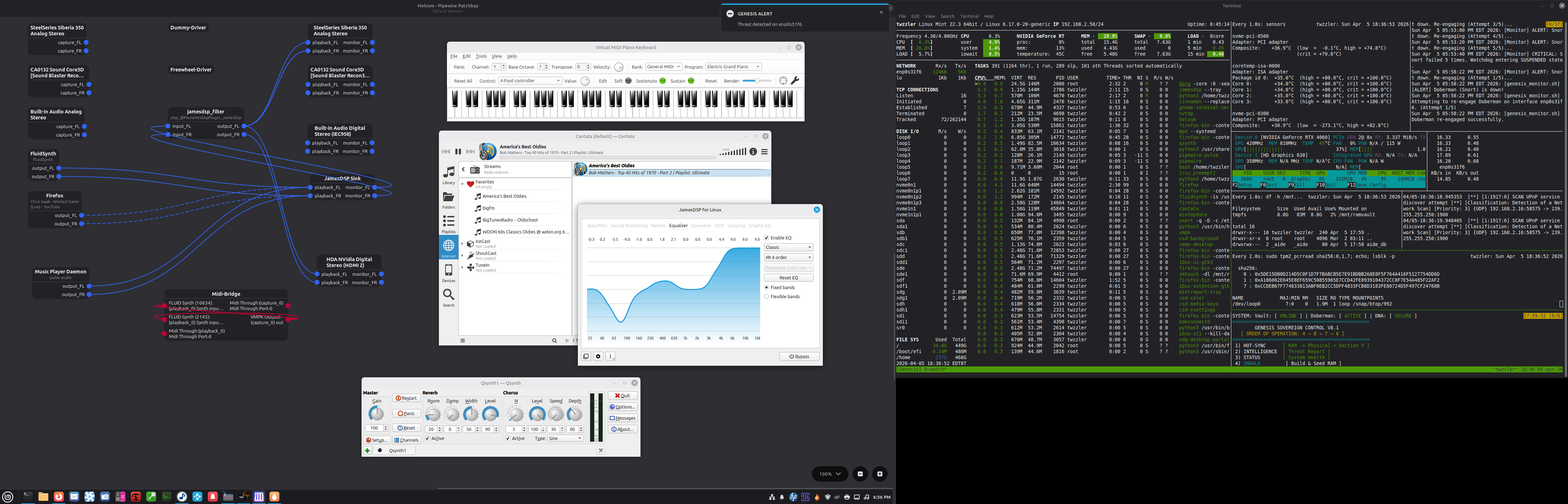
- The Impossible MIDI-Bridge
"With the PipeWire-ALSA-SEQ bridge, we no longer have to 'Make a Deal' with separate sound servers. Using VMPK (Virtual MIDI Piano Keyboard) and Qsynth, we can now pipe MIDI signals directly into the audio graph as if they were physical patch cables. This creates a Low-Latency environment where a virtual keyboard can trigger a 'Hardened' sound engine in real-time, bypasses the 'System Noise' of traditional software layers."
- The JamesDSP Shield
"Integrating JamesDSP directly into the Helvum patchbay allows for a Pro-Audio signal chain that is Immutable. We can route any source—from a Music Player Daemon (MPD) like Cantata to a web browser—through a custom 72% Hardening EQ profile before it ever touches the hardware. This ensures that even 'Rummy' low-quality streams are upscaled to a 'High-Fidelity' experience."
- The Migration of the "Invisible" Hardware
"The true magic of the Helvum-PipeWire Patchbay is the visibility of the 'Impossible.' Hardware like the Creative CA0132 (Sound Core3D), which remained silent for years on Linux, is now fully 'Exposed' as a quad-core DSP node. We can now manually route audio to specific hardware sub-channels, achieving a level of Symmetric Balance that was previously only available in a $50,000 professional studio setup."
- Freedom from the "Winblows" Sarcophagus
"We have moved from a 'Standard Setup' where the OS controls the user, to a Sovereign System where the user controls the OS. PipeWire doesn't just manage sound; it Unifies the Soul of the machine. Only on Linux can you see the 'Teeth of the Hydra' and wire them yourself."
Categories
- All Categories
- 178 LFX Mentorship
- 178 LFX Mentorship: Linux Kernel
- 774 Linux Foundation IT Professional Programs
- 383 Cloud Engineer IT Professional Program
- 175 Advanced Cloud Engineer IT Professional Program
- 75 DevOps IT Professional Program - Discontinued
- 7 DevOps & GitOps IT Professional Program
- 103 Cloud Native Developer IT Professional Program
- 7.6K Training Courses & Learning Paths
- 11 AI & ML Training
- 1 Blockchain & Decentralized Identity Training
- 32 Cloud & Containers Training
- 3 Cybersecurity Training
- 2 DevOps & Site-Reliability Training
- 1 Linux Kernel Development Training
- 2 Networking Training
- 2 Open Source Best Practice Training
- 5 System Administration Training
- 1 System Engineering Training
- 6 Web & Application Development Training
- 798 Hardware
- 202 Drivers
- 68 I/O Devices
- 37 Monitors
- 96 Multimedia
- 173 Networking
- 91 Printers & Scanners
- 92 Storage
- 772 Linux Distributions
- 81 Debian
- 68 Fedora
- 24 Linux Mint
- 13 Mageia
- 24 openSUSE
- 151 Red Hat Enterprise
- 31 Slackware
- 13 SUSE Enterprise
- 356 Ubuntu
- 469 Linux System Administration
- 31 Cloud Computing
- 73 Command Line/Scripting
- Github systems admin projects
- 101 Linux Security
- 79 Network Management
- 101 System Management
- 46 Web Management
- 162 Mobile Computing
- 30 Android
- 117 Development
- 1.2K New to Linux
- 1K Getting Started with Linux
- 405 Off Topic
- 127 Introductions
- 34 Study Material
- 1K Programming and Development
- 310 Kernel Development
- 719 Software Development
- 1K Software
- 418 Applications
- 182 Command Line
- 5 Compiling/Installing
- 71 Games
- 320 Installation
- Archived
- 183 Small Talk
- 2 LFD140 Class Forum
- 1.4K LFS258 Class Forum
Upcoming Training
-
August 20, 2018
Kubernetes Administration (LFS458)
-
August 20, 2018
Linux System Administration (LFS301)
-
August 27, 2018
Open Source Virtualization (LFS462)
-
August 27, 2018
Linux Kernel Debugging and Security (LFD440)