fatal errors with installing

i really do not know where else to ask...
after finishing the LF101 Course i made half of the introduction to kubernetes, now i switched to this course and well...i have installed minkube v1.34.2 and now i have fatal errors ..see picture....a teamviewer session would be a great help...but well....i guess i have to do it all again...maybe with a another machine...sorry this is disturbing..trying to get forward...well last but not least..these pdf are really more hard to copy than in the introduction course to kubernetes....have a good day kubernetes admins
regards bernhard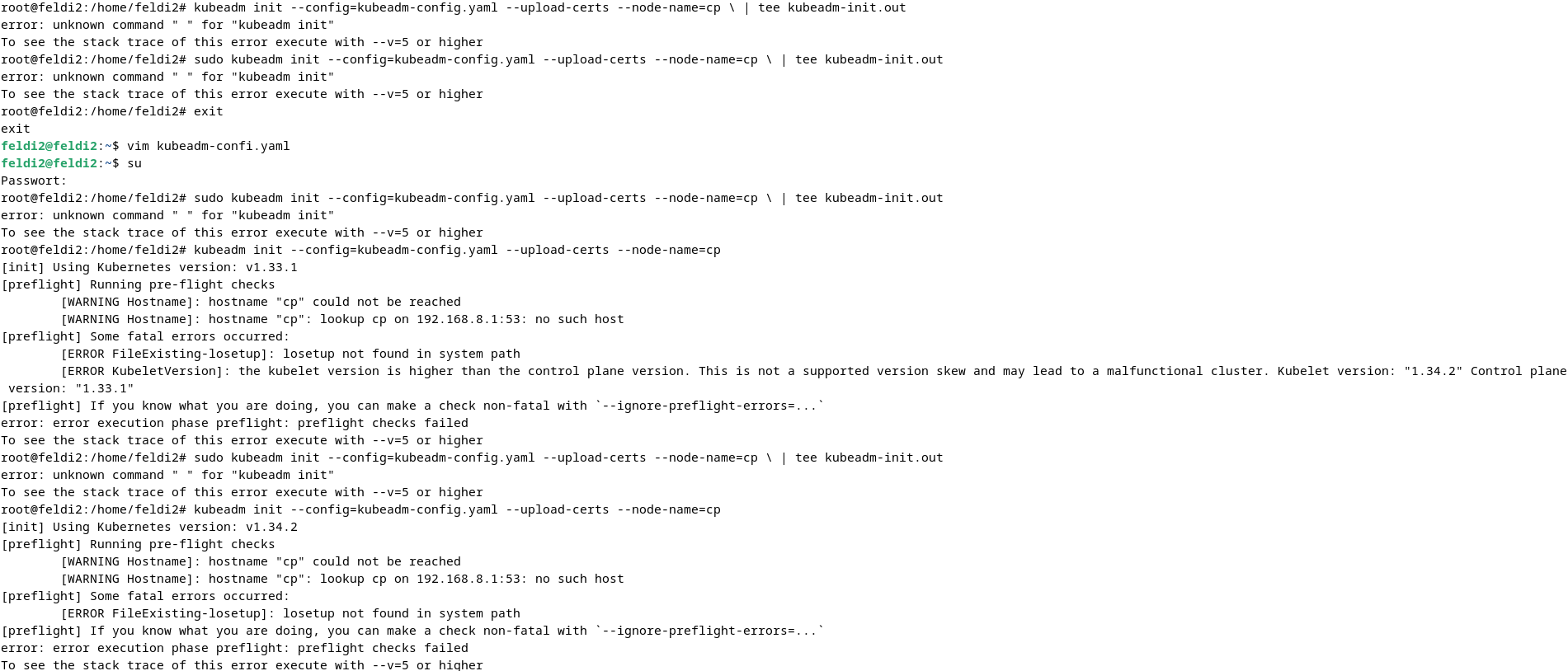
Best Answers
-
Hi @austrianadmin,
As you may have observed by now, each training course has its own strict environment requirements, and with that very distinct installation and configuration activities.
Mixing environments between courses is adversely impacting your progress. LFS258 assumes a clean setup on two clean VMs (cloud or local) - this avoids any conflicts with Minikube Kubernetes and other tools you may have installed. And, if the VMs get damaged beyond repair, they can be re-provisioned, allowing for a fresh new install of Kubernetes and its dependencies.
An observation from the output attached above: running
kubeadm initseveral times in sequence will not help your case, it will only produce the same errors over and over. Akubeadm resetis recommended after a failedinitto clean the environment. Also, ensure you follow the strict versioning schema from the LFS258 installation section, to avoid any conflicts and/or compatibility issues.Regards,
-Chris0 -
Hi @austrianadmin,
Per the Overview section in Lab exercise 3.1: Install Kubernetes, the recommended guest OS for the virtual environment is Ubuntu 24.04 LTS. This OS can be installed on two Virtual Machines, either cloud instances (AWS, Azure, Digital Ocean, Google Cloud, IBM Cloud, etc.) or local VMs (VirtualBox, KVM, Hyper-V, or other hypervisors that are supported by your host system).
If you prefer to deviate from the recommended setup and use a different guest OS on your Virtual Machines, then you need to find the software packages, gpg keys, and package manager source lists that are specific to the OS of your choice.
Keep in mind, however, that the lab exercises have been tested on Ubuntu 24.04 LTS, but not on other distributions.
While the host system OS can be Windows, MacOS, or a Linux distribution (Debian, etc.), the Virtual Machines hosting your lab environment would need to be running Ubuntu 24.04 LTS.
Regards,
-Chris0

Answers
-
Hi Chris,
thanks to your advise i deleteted the minikube, and started again writing the commands carefully, this was fine until....12. Install the containerd software.
root@cp: ̃# apt-get update && apt-get install containerd.io -y.....root@feldi2:/home/feldi2# sudo apt-get install containerd.io
E: malform entry 1 in list Datei /etc/apt/sources.list.d/docker.list (URI parse)
E: Die Liste der Quellen konnte nicht gelesen werden.(the list of the sources can not be read)
tried with cat....
root@feldi2:/home/feldi2# cat /etc/apt/sources.list.d/docker.list
deb [arch=amd64 signed-by=/etc/apt/keyrings/docker.gpg] \ https://download.docker.com/linux/ubuntu \ bookworm stable.....so my question is it because i have debian and not ubuntu?....otherwise i have no idea how to fix this.....after finishing the 101 course,i should have first done the linux sysadmin course and then the kubernetes admin, sorry for my questions...regards bernhard
0
Categories
- All Categories
- 178 LFX Mentorship
- 178 LFX Mentorship: Linux Kernel
- 775 Linux Foundation IT Professional Programs
- 384 Cloud Engineer IT Professional Program
- 175 Advanced Cloud Engineer IT Professional Program
- 75 DevOps IT Professional Program - Discontinued
- 7 DevOps & GitOps IT Professional Program
- 103 Cloud Native Developer IT Professional Program
- 7.7K Training Courses & Learning Paths
- 13 AI & ML Training
- 1 Blockchain & Decentralized Identity Training
- 35 Cloud & Containers Training
- 3 Cybersecurity Training
- 3 DevOps & Site-Reliability Training
- 2 Linux Kernel Development Training
- 2 Networking Training
- 2 Open Source Best Practice Training
- 5 System Administration Training
- 1 System Engineering Training
- 6 Web & Application Development Training
- 798 Hardware
- 202 Drivers
- 68 I/O Devices
- 37 Monitors
- 96 Multimedia
- 173 Networking
- 91 Printers & Scanners
- 92 Storage
- 773 Linux Distributions
- 81 Debian
- 68 Fedora
- 24 Linux Mint
- 13 Mageia
- 24 openSUSE
- 151 Red Hat Enterprise
- 32 Slackware
- 13 SUSE Enterprise
- 356 Ubuntu
- 472 Linux System Administration
- 31 Cloud Computing
- 73 Command Line/Scripting
- Github systems admin projects
- 103 Linux Security
- 79 Network Management
- 102 System Management
- 46 Web Management
- 166 Mobile Computing
- 32 Android
- 119 Development
- 1.2K New to Linux
- 1K Getting Started with Linux
- 407 Off Topic
- 128 Introductions
- 35 Study Material
- 1.1K Programming and Development
- 311 Kernel Development
- 723 Software Development
- 1K Software
- 418 Applications
- 183 Command Line
- 5 Compiling/Installing
- 71 Games
- 320 Installation
- Archived
- 183 Small Talk
- 2 LFD140 Class Forum
- 1.4K LFS258 Class Forum
Upcoming Training
-
August 20, 2018
Kubernetes Administration (LFS458)
-
August 20, 2018
Linux System Administration (LFS301)
-
August 27, 2018
Open Source Virtualization (LFS462)
-
August 27, 2018
Linux Kernel Debugging and Security (LFD440)